

Expertise Does Not Save You From Bias
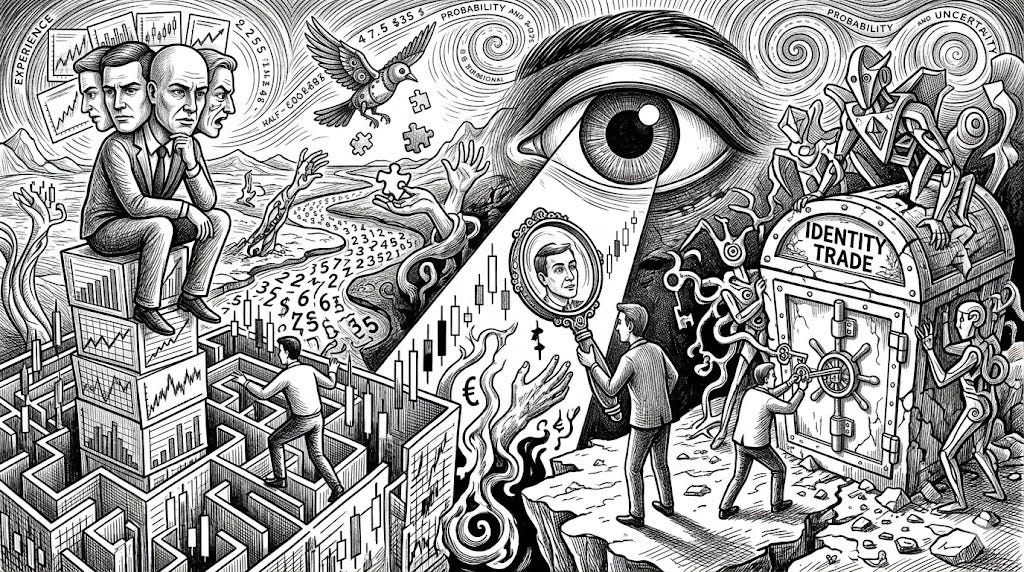
Experience matters, but it does not make you clean. It changes where your errors hide.

Expertise Does Not Save You From Bias
There is a dangerous moment in a trader’s development when the obvious mistakes start to disappear.
You stop chasing every candle.
You stop blowing up on impulse every other week.
You stop taking random trades just because the market is open.
You get better.
Your entries become cleaner. Your risk becomes more controlled. Your review process becomes more serious. You know your market. You know your setup. You know what a beginner mistake looks like, and most days, you are not making those anymore.
That is real progress.
But it also creates a new problem.
Because once you stop looking like an emotional beginner, it becomes easier to believe your judgment is cleaner than it really is.
You no longer say, “I am revenge trading.”
You say, “I am pressing an edge.”
You no longer say, “I am afraid to be wrong.”
You say, “I am giving the trade more room.”
You no longer say, “I am attached to my thesis.”
You say, “I have seen this pattern before.”
And that is where experience can become dangerous.
Not because experience is useless. It is not.
Experience matters. Skill matters. Pattern recognition matters. Time in the seat matters. A serious trader is not the same as someone gambling from a phone with no plan.
But expertise does not make you free from bias.
It changes the kind of bias you are vulnerable to.
The beginner gets trapped by obvious emotion.
The experienced trader gets trapped by believable judgment.
That difference matters.
Because the more skilled you become, the less your errors look like errors in real time.
They start sounding intelligent.
They start sounding earned.
They start sounding like discretion.
And sometimes they are.
That is what makes this so hard.
The beginner problem is easier to see
A new trader is usually easier to diagnose.
He chases.
He over sizes.
He moves stops.
He revenge trades after a loss.
He exits too early because green feels too precious.
He refuses to take a loss because red feels like personal failure.
It is painful, but it is visible.
The trade journal almost screams the truth back at him. There was no setup. There was no plan. There was no risk control. There was only emotion wearing the mask of urgency.
The beginner has a bias problem, but at least the bias is clumsy.
The experienced trader is different.
He may follow the setup. He may use proper size. He may have years of chart time behind him. He may know the language of probability, expectancy, variance, context, and process.
His errors are not always obvious violations.
They live closer to the edge of judgment.
A small exception.
A slightly wider stop.
A selective reading of context.
A refusal to reduce size because he has “earned” the right to trade bigger.
A decision to trust instinct when the written plan says stand down.
A belief that this market is different because he has seen something similar before.
None of this looks reckless from the outside.
Sometimes it even looks professional.
That is the point.
As you improve, bias does not always disappear. It gets better dressed.
Expertise can reduce some mistakes and strengthen others
There are things experience genuinely improves.
You do recognize bad setups faster.
You do learn what certain conditions usually produce.
You do become less surprised by normal loss.
You do stop needing every trade to validate you.
You do develop a better feel for when the market is clean and when it is just noise.
That is not imaginary. A trader with years of serious review should not behave like a beginner forever.
But experience is selective.
You can improve in one domain and still be distorted in another.
You can be excellent at reading structure and terrible at honoring invalidation.
You can be calm entering trades and emotional exiting them.
You can understand risk mathematically and still hate taking a loss emotionally.
You can teach discipline to other people and still make private exceptions when your own identity feels threatened.
That is the uncomfortable part.
Skill does not spread evenly across the whole person.
A trader can be mature in analysis and immature in exposure.
He can be patient before entry and needy after entry.
He can know his setup deeply and still misread himself under pressure.
This is why the phrase “experienced trader” is not enough.
Experienced at what?
Experienced at chart reading?
Experienced at holding winners?
Experienced at cutting losers?
Experienced at surviving drawdowns?
Experienced at telling the truth in review?
Those are not the same skill.
A lot of traders hide behind the general label because it feels good. They call themselves experienced, but they never ask where their experience actually protects them and where it does not.
That is how the next level of bias survives.
It hides inside the areas you have stopped questioning.
The more you know, the easier it is to defend the wrong thing
A beginner usually has weak excuses.
An experienced trader has better ones.
That sounds harsh, but watch how it happens.
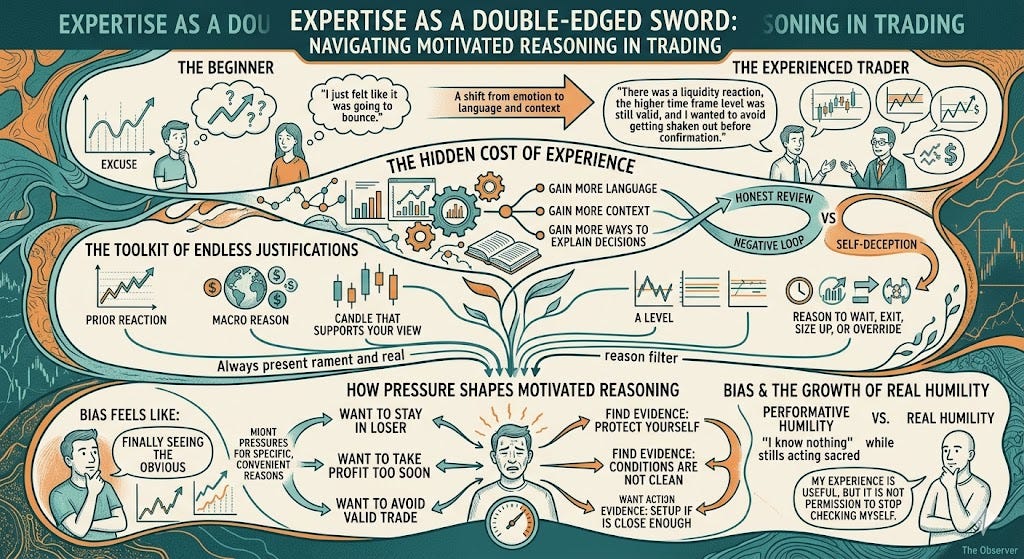
The beginner says, “I just felt like it was going to bounce.”
The experienced trader says, “There was a liquidity reaction, the higher time frame level was still valid, and I wanted to avoid getting shaken out before confirmation.”
Maybe that is true.
Maybe it is also a beautiful sentence wrapped around fear.
This is one of the hidden costs of expertise. You gain more language. You gain more context. You gain more ways to explain a decision after the fact.
That can improve review when you are honest.
It can also protect you from seeing yourself.
The more market knowledge you carry, the easier it becomes to find a reason for almost anything.
There is always a level.
Always a prior reaction.
Always a macro reason.
Always a candle that supports your view.
Always a reason to wait.
Always a reason to exit.
Always a reason to size up.
Always a reason to override.
The problem is not that these reasons are fake. Some of them are real.
The problem is that pressure changes which reasons you reach for.
When you want to stay in a loser, you find the evidence that says give it room.
When you want to take profit too soon, you find the evidence that says protect yourself.
When you want to avoid a valid trade after a loss, you find the evidence that says conditions are not clean.
When you want action, you find the evidence that says the setup is close enough.
This is not a lack of intelligence.
It is motivated reasoning.
Your mind is not only searching for truth. Under pressure, it is also searching for relief.
And the more skilled you are, the more sophisticated your relief can sound.
Bias does not always feel like distortion.
Sometimes it feels like finally seeing the obvious.
That is why humility has to grow with skill.
Not fake humility.
Not the performative kind where you say “I know nothing” while still acting like your read is sacred.
Real humility.
The kind that says, “My experience is useful, but it is not permission to stop checking myself.”
Where the bias moves
As you mature, your bias often moves from obvious action to subtle interpretation.
In the beginning, the problem is usually what you do.
You click too fast.
You trade too big.
You hold too long.
You chase.
Later, the problem often becomes how you interpret what you are seeing.
You call hesitation patience.
You call fear caution.
You call stubbornness conviction.
You call boredom preparation.
You call emotional relief discipline.
This is the advanced trap.
The behavior becomes harder to judge because it can look clean on the surface.
You did not break your rules loudly.
You bent them quietly.
You did not enter a random trade.
You stretched the definition of your setup.
You did not revenge trade with obvious anger.
You took a “high conviction continuation play” five minutes after being stopped out.
You did not panic exit.
You “respected developing weakness” the second the trade made you uncomfortable.
The account may not explode from this.
That makes it more dangerous in a different way.
Beginner bias often creates dramatic damage.
Experienced bias often creates quiet decay.
It bleeds expectancy.
It distorts review.
It lowers trust in the system.
It makes your data less clean.
It creates a version of you that is almost disciplined, almost consistent, almost honest.
Almost is expensive.
Because when your mistakes are dramatic, you are forced to confront them.
When your mistakes are subtle, you can live with them for years.
The hidden cost is not just money
Most traders only measure the cost of bias by the trade result.
That is too shallow.
A biased decision can make money.
A clean decision can lose money.
You already know that.
But the deeper cost of bias is not always the single outcome. It is the damage it does to your ability to trust your own process.
Every time you override and get rewarded, you teach yourself that exceptions are intelligence.
Every time you override and get punished, you teach yourself that you cannot trust yourself.
Both are dangerous.
The first creates arrogance.
The second creates hesitation.
Over time, this becomes a chain reaction.
You make one biased decision.
Then your review becomes biased because you want to protect the decision.
Then your next session begins with distorted confidence or distorted fear.
Then you either press too hard or pull back too much.
Then you blame the system, the market, your psychology, or your read.
But the real problem started earlier.
It started when you treated experience as protection instead of evidence that needed review.
This is why experienced traders can stay stuck for so long.
They are not failing because they know nothing.
They are failing because they know enough to keep defending the leak.
The experienced trader’s most dangerous sentence
There is one sentence that should put you on alert.
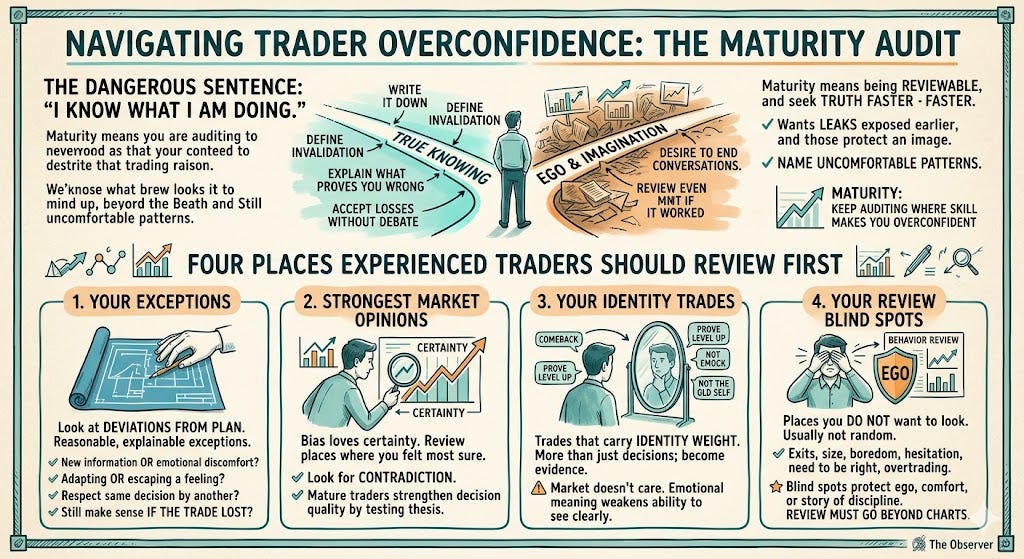
“I know what I am doing.”
Sometimes that sentence is calm truth.
Sometimes it is ego trying to end the conversation.
The difference is in what happens next.
If you know what you are doing, you should be able to write it down.
If you know what you are doing, you should be able to define the invalidation.
If you know what you are doing, you should be able to explain what would prove you wrong.
If you know what you are doing, you should be able to accept the loss without turning it into a debate.
If you know what you are doing, you should be willing to review the decision even if it worked.
Experience should make you more reviewable, not less.
That is the standard.
The more serious you become, the less interested you should be in protecting your image as a serious trader.
You should want the truth faster.
You should want the leak exposed earlier.
You should want the uncomfortable pattern named before it becomes part of your identity.
That is what maturity looks like.
Not perfection.
Not emotional numbness.
Not never being biased.
Maturity is the willingness to keep auditing the places where your skill makes you overconfident.
The four places experienced traders should review first
If you have been trading long enough to know better, do not ask, “Am I biased?”
You are.
Ask where.
That question is more useful.
Start with these four areas.
1. Your exceptions
Look at the trades where you deviated from plan.
Not the insane ones.
The reasonable ones.
The ones you can explain.
The ones that sound mature.
Ask yourself:
Did this exception come from new information or emotional discomfort?
Was I adapting to the market or escaping a feeling?
Would I respect this same decision if another trader made it?
Would this exception still make sense if the trade had lost?
That last question matters.
Outcome has a way of cleaning up ugly decisions after the fact.
Do not let it.
2. Your strongest market opinions
Bias loves certainty.
So review the places where you felt most sure.
The trades where you said, “This has to go.”
The days where the market felt obvious.
The setups where you stopped looking for evidence against your idea.
Certainty is not always wrong, but it narrows vision.
The more convinced you are, the more deliberately you need to look for contradiction.
A mature trader does not weaken his thesis by testing it.
He strengthens his decision quality.
3. Your identity trades
These are trades that mean more than they should.
The comeback trade after a bad week.
The trade after posting a strong month.
The trade after missing a major move.
The trade where you want to prove you have leveled up.
The trade where you want to show that you are not the old version of yourself anymore.
These trades are dangerous because they carry identity weight.
They are no longer just decisions.
They become evidence.
Evidence that you are good.
Evidence that you are disciplined.
Evidence that you are back.
Evidence that you are still him.
Once a trade starts carrying that much emotional meaning, your ability to see clearly begins to weaken.
The market does not care what the trade represents to you.
It only cares what orders are there.
4. Your review blind spots
Every trader has a place he does not want to look.
For some, it is exits.
For some, it is size.
For some, it is boredom.
For some, it is hesitation after losses.
For some, it is the need to be right on direction.
For some, it is the inability to stop trading after the best opportunity of the day is gone.
Your blind spot is usually not random.
It protects something.
It protects your ego.
It protects your comfort.
It protects your story about being disciplined.
It protects your hope that the next breakthrough will come from more market knowledge instead of more honesty.
That is why review has to go beyond charts.
Your chart review may show what happened.
Your behavior review shows why you participated the way you did.
You need both.
A better review question
Most traders ask:
“Was this a good trade?”
That question is not bad, but it is incomplete.
A better question is:
“What kind of bias was I most vulnerable to in this decision?”
That changes the review.
Now you are not just grading the setup.
You are mapping your own pattern.
You are learning your bias profile.
This is important because your bias profile will not look exactly like mine.
Some traders are biased toward action. They see opportunity everywhere.
Some are biased toward avoidance. They miss clean trades because loss has become too emotionally expensive.
Some are biased toward confirmation. They fall in love with a thesis and filter everything through it.
Some are biased toward relief. They exit the second the trade gives them permission to stop feeling pressure.
Some are biased toward identity. Every outcome becomes a verdict on who they are.
Some are biased toward expertise itself. They believe their experience gives them permission to operate without the same constraints that protected them while they were developing.
That last one is subtle.
And it ruins a lot of traders who should know better.
The bias profile review
Use this after each session for two weeks.
Keep it simple. Do not turn it into a giant performance ritual you will abandon by Thursday.
After the session, choose the strongest bias that showed up.
Only one.
Not five.
One.
Then write three sentences.
The decision where it showed up was
Name the exact trade or non trade.
The bias sounded reasonable because
Write the justification you used in real time.
Next time, I will require
Write one constraint that makes the same bias harder to obey.
That is it.
Here is what it might look like.
The decision where it showed up was holding my short after price reclaimed my invalidation level.
The bias sounded reasonable because I told myself the larger trend was still bearish and I did not want to get shaken out.
Next time, I will require immediate exit when price accepts beyond invalidation, and I can only reenter if a new setup forms after I am flat.
That is useful.
Not because it is complicated.
Because it forces truth.
It separates the market reason from the emotional reward.
It teaches you to hear the tone of your own bias.
Over time, patterns will repeat.
That is good.
Repetition means you have found the real work.
You may notice that you are not broadly undisciplined. You may be very disciplined until a trade threatens your identity.
You may notice that you are not bad at exits. You may be bad at sitting with unrealized profit because you crave relief.
You may notice that you are not impatient every day. You may become impatient only after two valid trades pass without you.
That level of detail matters.
General shame does not improve traders.
Specific truth does.
Better work looks less impressive than you think
The next level is not always more confidence.
Sometimes it is more restraint.
Sometimes it is lowering size when your read feels emotionally loaded.
Sometimes it is honoring the stop even when every part of you can explain why the stop is too tight.
Sometimes it is admitting that your market opinion is strong but your trade location is poor.
Sometimes it is skipping a setup because you can feel the need to be right inside it.
Sometimes it is reviewing a winning trade and saying, “This made money, but the decision was contaminated.”
That is serious work.
Most traders only review pain.
Professionals review contamination.
They know a profitable mistake is still a mistake.
They know a losing clean trade still protects the system.
They know the goal is not to feel smart.
The goal is to make decisions that can survive review.
That is the part of expertise worth building.
Not the identity.
Not the status.
Not the feeling that you have finally outgrown the ugly parts of your psychology.
You do not outgrow being human.
You build processes that respect the fact that you are human.
The final test of experience
Experience is not proven by how strongly you can defend your read.
It is proven by how quickly you can surrender a bad one.
It is not proven by how much market language you know.
It is proven by whether that language helps you see clearly or helps you hide.
It is not proven by never feeling bias.
It is proven by noticing where bias has moved.
The beginner has to learn that emotion is expensive.
The experienced trader has to learn that intelligence can become expensive too.
Because once you know enough, you can explain almost anything.
You can explain the hold.
You can explain the chase.
You can explain the hesitation.
You can explain the size increase.
You can explain the exception.
The question is not whether you can explain it.
The question is whether the explanation is true.
That is where the work is.
Expertise should make you more dangerous to your own excuses.
It should make you harder to fool.
It should make your process cleaner, your review sharper, and your identity less fragile.
But it will not do that automatically.
Time in the market gives you exposure.
It does not guarantee wisdom.
Wisdom begins when you stop treating experience as a shield and start treating it as another thing that needs to be examined.
You are not trying to become a trader with no bias.
You are trying to become a trader who knows where his bias goes next.
That is a different standard.
A better one.
And if you are serious, it is the only one that holds.
If this piece resonated with you, the subscriber chat is where we take this work deeper.
It is a private psychology workshop for traders who want to get serious about execution, discipline, identity, and self observation. Not surface level talk. Not hot takes. Not performance. Real work.
Inside the chat, we break down the mental leaks behind overtrading, hesitation, revenge trading, fear, ego, self sabotage, and inconsistency. We use frameworks, reflection, and honest discussion to turn trading psychology into something practical.
The articles give the framework. The chat is where we do the work.
Join us inside.
