The Hougaard Model: Why the Best Trader Is the Best Loser (Book series)
Why the Best Trader Is the Best Loser

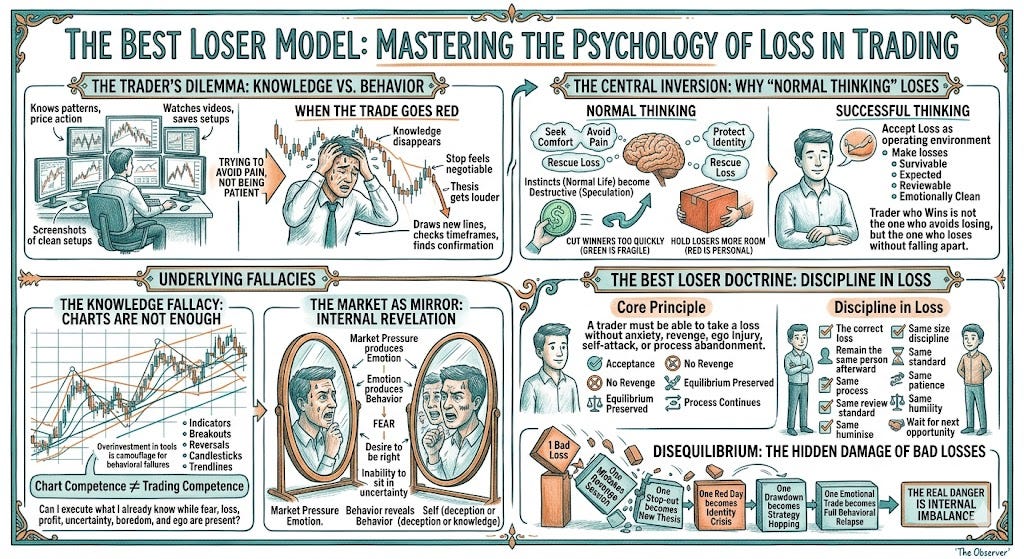
Tom Hougaard’s Best Loser Wins argues that trading success is not built on avoiding loss, but on learning to lose without emotional collapse, revenge, ego injury, or process abandonment.
There is a certain kind of trader who knows enough to be dangerous.
He can read price action.
He knows the patterns.
He has watched enough videos, marked enough charts, saved enough setups, and probably has a few clean screenshots that make him feel like he understands the game.
Then the trade goes red.
And all that knowledge disappears.
The stop suddenly feels negotiable. The thesis gets louder. The chart starts producing reasons. He zooms out, draws a new line, checks another timeframe, finds a post that agrees with him, and tells himself he is being patient.
He is not being patient.
He is trying to avoid pain.
That is the heart of Tom Hougaard’s Best Loser Wins. The book is not really about becoming better at predicting markets. It is about becoming harder to emotionally destabilize when the market does what markets do: contradict you, tempt you, humiliate your ego, give you unrealized profit, take it back, and expose the weak points in your mind.
The strongest model in the book can be called the Hougaard Best Loser Model. That label is a clean study name for Hougaard’s framework, not a phrase we need to pretend he formalized as a doctrine. The operating logic is clear: the trader who wins is not the one who avoids losing, but the one who loses without falling apart.
Core insight:
In trading, loss is not the exception. Loss is the operating environment. The question is not whether you will lose. The question is what losing turns you into.
The Central Inversion: Normal Thinking Loses
Hougaard’s subtitle matters: Why Normal Thinking Never Wins the Trading Game.
That is not just clever packaging. It is the book’s entire psychological claim.
Normal thinking wants comfort. It wants to avoid pain. It wants to protect identity. It wants to turn loss into rescue. It wants to take profit quickly because green feels fragile. It wants to give losers more room because red feels personal. It wants certainty from a market that will never provide it.
In normal life, that makes sense.
If something hurts, you move away.
If something gives relief, you secure it.
If you are wrong, your ego tries to protect you.
If you are uncertain, you search for more information.
But trading takes those ordinary instincts and turns them against you.
The brief describes Hougaard’s “normal thinking” as the human pattern of avoiding pain, seeking comfort, protecting ego, hoping losers recover, taking profits too quickly, adding to losers, under-adding to winners, and searching for certainty in an uncertain environment. That operating system may be adaptive in ordinary life, but it becomes destructive in speculation.
This is why so many traders do the exact opposite of what they know they should do.
They cut the winner because they fear losing open profit.
They hold the loser because they fear realizing pain.
They add to the bad trade because the lower price feels like a bargain.
They hesitate to add to the good trade because being right now feels too precious to risk.
The market does not need to beat them.
Their nervous system does it first.
The Problem Is Not That Traders Know Nothing
One of Hougaard’s sharpest arguments is that most traders are not failing because they lack access to information.
Charts are everywhere. Indicators are everywhere. Pattern names are everywhere. Technical analysis is not hidden behind a locked door anymore. A serious trader can learn support, resistance, trendlines, breakouts, reversals, candlestick patterns, and moving averages quickly enough.
The problem is that chart competence is not the same thing as trading competence.
Hougaard attacks the retail fantasy that the next tool will fix the trader. More lines. More indicators. More confirmation. More pattern names. More timeframes. More complexity.
But often that is not analysis.
It is camouflage.
It is a way to avoid the simpler and uglier question:
Can I execute what I already know while fear, loss, profit, uncertainty, boredom, and ego are present?
The research brief frames this as Hougaard’s critique of technical-analysis insufficiency: chart knowledge is easy to acquire but insufficient for performance, and overinvestment in tools can distract traders from the behavioral failures actually damaging them.
This does not mean charts are useless.
That would be a lazy reading.
Hougaard is not saying edge, stops, analysis, or method do not matter. He is saying that technical knowledge is widely available but not behaviorally executed. A trader can have enough market knowledge to identify opportunity and still lack the internal structure to lose, hold, add, recover, and review properly.
That distinction matters.
A weak trader often thinks, “I need a better setup.”
Hougaard’s model asks a harder question:
What happens to you after the setup appears?
The Market as Mirror
The book begins by turning the trader’s gaze away from the market and back toward the self.
That is uncomfortable because traders usually come to the market looking for external mastery. They want to understand price. They want to understand institutions. They want to understand order flow, liquidity, news, momentum, and the crowd.
All of that can matter.
But Hougaard’s deeper point is that the market reveals the trader’s internal structure. It exposes impatience. It exposes ego. It exposes fear. It exposes the desire to be right. It exposes the inability to sit in uncertainty without reaching for control.
The brief identifies this as a “market-as-mirror” framing: market pressure produces emotion, emotion produces behavior, and behavior reveals self-knowledge or self-deception.
That is why trading is so personal.
Not because the market cares about you.
It does not.
Trading feels personal because your reactions keep telling the truth about what you worship.
If you worship being right, you will hold losers.
If you worship comfort, you will cut winners.
If you worship action, you will overtrade.
If you worship certainty, you will drown in analysis.
If you worship daily income, every red day will feel like a threat to your identity.
The market is not attacking you.
It is revealing you.
Why Losing Well Matters More Than Avoiding Loss
The amateur wants to eliminate losses.
The professional wants to make losses survivable, expected, reviewable, and emotionally clean.
That is the difference.
Hougaard’s central doctrine is not “enjoy losing.” It is not “losses do not matter.” It is not “be reckless and fearless.” It is much more precise:
A trader must be able to take a loss without anxiety, revenge, ego injury, self-attack, or process abandonment.
The brief names this as the “Best Loser Doctrine”: trading success depends on losing well rather than avoiding loss; the trader accepts loss, avoids revenge, preserves equilibrium, and continues the process.
This is where most traders misunderstand discipline.
They think discipline is the ability to force a win.
It is not.
Discipline is the ability to take the correct loss and remain the same person afterward.
Same process.
Same size discipline.
Same review standard.
Same patience.
Same humility.
Same ability to wait for the next valid opportunity.
A bad loss is not just the money lost.
The hidden damage is what the loss makes you do next.
One loser becomes two.
One mistake becomes a revenge session.
One stop-out becomes a new thesis.
One red day becomes an identity crisis.
One drawdown becomes strategy hopping.
One emotional trade becomes a full behavioral relapse.
Hougaard’s model forces the trader to see that the losing trade is not always the real danger.
The real danger is disequilibrium.
The moment you are no longer internally balanced, the market owns you.