

Imposter Dynamics in Trading: Why Winning Still Feels Undeserved
Some traders erase their own progress by dismissing clean wins as luck, keeping confidence fragile even when their execution is improving.

You finally take the trade the way you were supposed to.
You wait. You do not chase. You let price come into your area. You size it the way you planned. You manage it without turning the middle of the trade into an emotional negotiation.
It works.
And by the time the day is over, you are already explaining it away.
Easy market. Lucky timing. Obvious setup. A clean day anyone could have traded.
Then the next session shows up and you feel like you are back at zero again.
This is where a lot of traders stay confused. They think they have a confidence problem. Sometimes they do.
But sometimes the real problem is uglier than that.
Sometimes you do not have a confidence problem. You have a proof rejection problem.
You are collecting evidence and then disqualifying it.
That matters because confidence is supposed to build from repeated contact with reality. If you keep refusing to let reality count, then every good trade disappears before it can strengthen anything in you.
This is different from honest doubt
Honest doubt is not the enemy.
If your sample is still thin, your read is still messy, or your setup quality is still unstable, then uncertainty is appropriate. That is not pathology. That is honest calibration.
This pattern is different.
This is when you already have at least some real competence evidence and still refuse to let it update your self view.
Not fantasy. Not affirmation. Not hype.
Actual proof.
You have seen the setup enough times. You have handled enough trades well. You have enough clean reps that something in your process should be starting to feel more stable.
But the update never lands.
The win becomes luck. The clean trade becomes ordinary. The progress becomes temporary. The strong day becomes a fluke.
Then one bad trade comes along and suddenly that counts.
That is the trap.
If wins stay external and losses become personal, you create a confidence system that can only stay fragile.
Why smart traders keep doing this
This pattern survives because it sounds responsible in real time.
It sounds humble. It sounds grounded. It sounds like you are protecting yourself from arrogance.
You tell yourself you are staying realistic. You tell yourself you are not getting carried away. You tell yourself you are refusing to overrate a small sample.
Sometimes that is true.
But there is a line between staying grounded and refusing to update.
Healthy grounding says:
This trade does not prove everything, but it does count for something.
This pattern says:
This trade does not count, and if I trust it, I will probably expose myself later.
That second response is not maturity. It is self protection.
And the protection usually sounds smarter than it is.
Because now you can keep working without ever letting the work mean anything. You can keep studying without ever having to say you are improving. You can stay in the safer identity of still getting there.
That identity can feel weirdly comfortable. Because once you admit the progress is real, the next trade feels like it matters more. And once the next trade feels like it matters more, being wrong starts to feel more exposing.
Why success can make you tighter instead of calmer
A lot of traders expect confidence to rise in a straight line. Do good work, feel better, execute better, repeat.
Sometimes it works like that. A lot of the time it does not.
Sometimes a stronger week makes you tighter. A funded account makes you smaller. A better month makes you more hesitant. A good run makes you more careful in the wrong way.
Why?
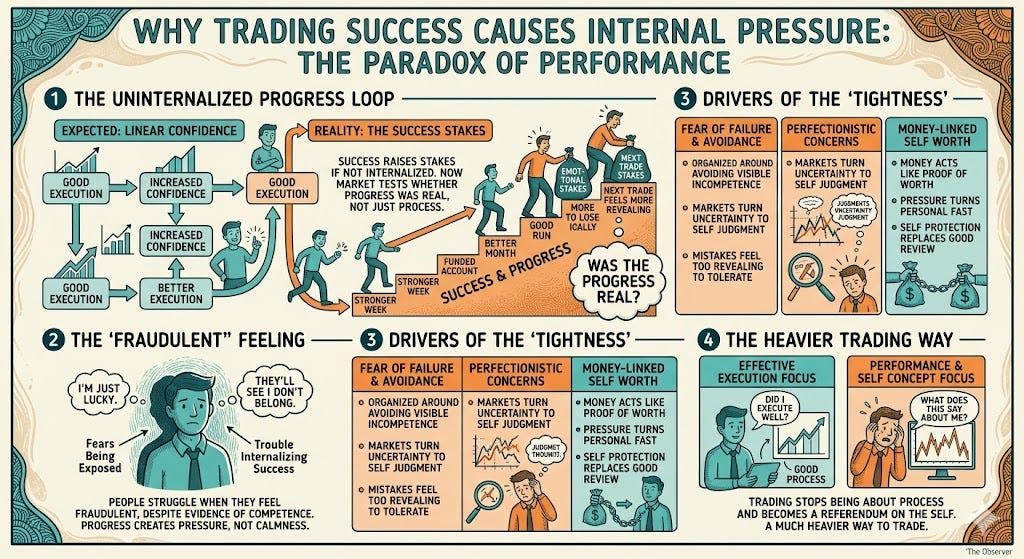
Because success raises the emotional stakes if you have not learned how to carry it.
Now there is more to lose psychologically. Now the next trade feels more revealing. Now the market is not just testing your process. It feels like it is testing whether the progress was real.
This is where traders get themselves backwards. They assume more evidence should automatically calm them down. But if the problem is that success never gets internalized, then more evidence can actually create more pressure.
Not because progress is bad. Because you have not learned how to let progress become part of your self concept without turning it into a referendum.
The better evidence keeps circling the same problem
This topic needs some restraint. The construct is not clean enough to use casually like a diagnosis. Measurement has been messy, and trader specific direct evidence is still thin.
That said, the better evidence still points toward a real cluster. People struggle when they feel fraudulent, fear being exposed, and have trouble internalizing success even when there is real evidence of competence.
That is the part traders should care about.
One of the clearer findings is that fear of failure matters a lot, especially when the person is already organized around avoiding visible incompetence. That matters on a chart because markets create constant chances for uncertainty to turn into self judgment.
Another strong point is that perfectionistic concerns matter more than just having high standards. That matters because plenty of traders hide behind the language of standards when the deeper issue is that mistakes feel too revealing to tolerate cleanly.
Work on money linked self worth matters too. When money starts acting like proof of worth, pressure does not stay financial. It turns personal fast. And once it turns personal, good review gets replaced by self protection.
Put more simply, you stop asking:
Did I execute well?
And start asking, usually without admitting it:
What does this say about me?
That is a much heavier way to trade.
The hidden cost is not just hesitation
The obvious cost is easy to see. Missed trades. Under sizing. Late entries. Extra caution in moments that actually required clean action.
The deeper cost is worse.
This pattern blocks confidence from compounding.
Real confidence is not a feeling you manufacture. It is evidence that gets digested properly.
You do good work. You record it honestly. You let it count. You carry it into the next rep without turning it into ego theater.
That is how confidence becomes more stable.
But if you keep erasing the evidence, the loop breaks.
Now every session starts from scratch. Every trade feels heavier than it should. Every mistake feels more informative than every clean rep. Every good day becomes something you have to re earn tomorrow.
That creates a brutal chain reaction.
You execute well. You dismiss it. You stay unconvinced. The next moment still feels loaded. You get tight. You hesitate or hide. That hesitation creates a worse result. Then the worse result gets treated like proof.
By the end of that cycle, you feel justified in not trusting yourself.
That is why this problem is so expensive. It does not just make you late on one trade. It keeps your whole confidence system stuck in beginner mode.
Three places this pattern usually reveals itself
You do not need a giant model for this. But you do need a sharper eye.
1. You erase clean work with soft language
You use phrases like:
decent trade
not bad
got lucky
market helped
still not sure
That kind of language sounds harmless. A lot of the time it is how you erase usable proof.
2. You make losses more meaningful than wins
A win becomes conditions. A loss becomes identity.
That asymmetry is one of the biggest tells in this pattern.
3. You get tighter as the evidence improves
You would think more progress would create more freedom. Instead it creates more caution, more hesitation, and more need for reassurance.
That usually means the issue is no longer just execution. It is what execution is starting to mean about you.
Traders usually call this discipline when it is really evidence refusal
This is where the review often goes off the rails.
You tell yourself:
I need more confidence
I need more discipline
I need to trust myself
I need to stop being scared
Those lines are not always wrong. They are just too vague to help much.
If the real problem is that you will not let valid execution count as proof, then motivation is not the fix. More self talk is not the fix. More random screen time is not the fix.
The job is different.
You need to learn how to:
recognize competence without turning it into arrogance
let process evidence count without demanding that one trade prove everything
separate outcome risk from identity threat
stop using false humility to keep yourself psychologically uncommitted
That is much more specific work than “be more disciplined.”
The tool: The Success Count Audit
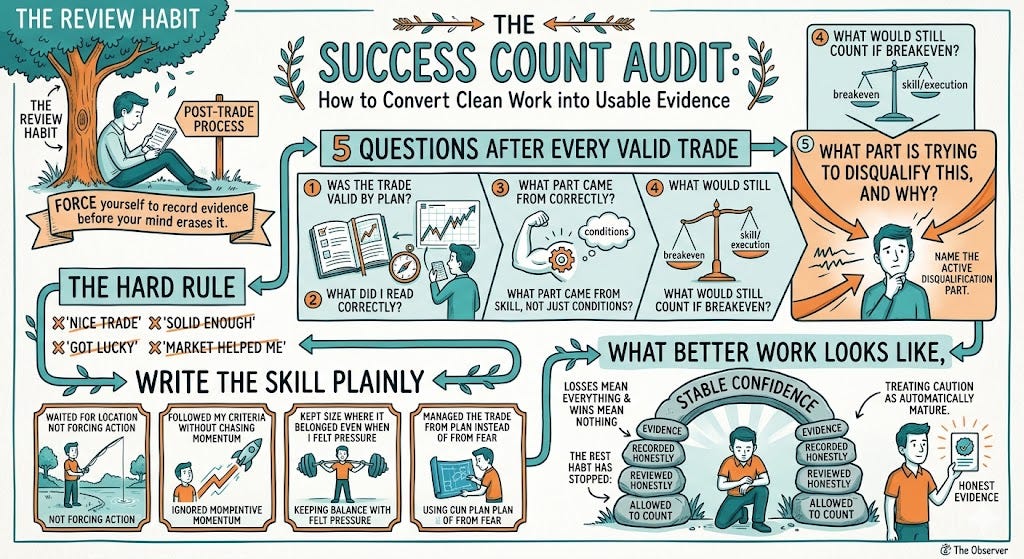
If your wins keep evaporating, you need a review habit that forces you to convert clean work into usable evidence before your mind can erase it.
Use this after every valid trade, especially the ones you are tempted to dismiss.
Answer these five questions in writing.
Was the trade valid by plan?
What did I read correctly?
What part of the result came from skill, not just conditions?
What would still count if this trade had been breakeven?
What part of me is trying to disqualify this, and why?
That fifth question is the upgrade most traders need. Because this pattern is not just about weak review. It is about active disqualification. Something in you is trying to keep the proof from landing. Name that part. Do not let it stay vague.
Here is the hard rule.
Do not end the review with soft language. Do not write:
nice trade
solid enough
got lucky
market helped me
maybe I read it okay
Write the skill plainly.
Examples:
I waited for location instead of forcing action.
I followed my criteria without chasing momentum.
I kept size where it belonged even when I felt pressure.
I managed the trade from plan instead of from fear.
That matters because confidence needs language. If you never state what you did well, your mind has nothing solid to build on.
What better work looks like
Better work does not mean walking around feeling convinced all the time.
It means something quieter and stronger.
You stop asking every trade to settle your identity. You stop treating caution as automatically mature. You stop using extra preparation to solve a problem that is really about exposure. You stop making losses mean everything and wins mean nothing.
And most importantly, you let valid execution count.
Not as proof that you have arrived. Not as permission to get arrogant. Not as a reason to start fantasizing.
Just as honest evidence.
That is enough. That is actually how stable confidence gets built.
Not through hype. Not through affirmations. Not through pretending fear is gone.
Through evidence. Recorded honestly. Reviewed honestly. Allowed to count.
One final distinction that matters
Not every hesitant trader is dealing with this.
Sometimes the process really is weak. Sometimes the setup is not clear enough. Sometimes size is distorting everything. Sometimes uncertainty tolerance is the bigger problem. Sometimes money has become self worth and every trade now feels like a verdict.
That is why this article should not be used like a label. Use it like a question.
Am I lacking proof, or am I refusing to let proof count?
That question will get you further than another speech about confidence.
Because if the second one is true, the work is not to become more certain. The work is to stop erasing your own evidence.
If this piece resonated with you, the subscriber chat is where we take this work deeper.
It is a private psychology workshop for traders who want to get serious about execution, discipline, identity, and self observation. Not surface level talk. Not hot takes. Not performance. Real work.
Inside the chat, we break down the mental leaks behind overtrading, hesitation, revenge trading, fear, ego, self sabotage, and inconsistency. We use frameworks, reflection, and honest discussion to turn trading psychology into something practical.
The articles give the framework. The chat is where we do the work.
Join us inside.

Sources
Bravata et al. on impostor phenomenon, correlates, and treatment limits
Gisselbaek et al. on concept, context, and intervention ambiguity
Mak, Kleitman, and Abbott on measurement problems in impostor scales
Hill and Gotwals on perfectionistic concerns and impostor phenomenon
Noskeau, Santos, and Wang on fear of failure and performance avoid orientation
Brauer and Wolf on workplace impostor patterns, anxiety, and procrastination
Park, Ward, and Naragon Gainey on financially contingent self worth